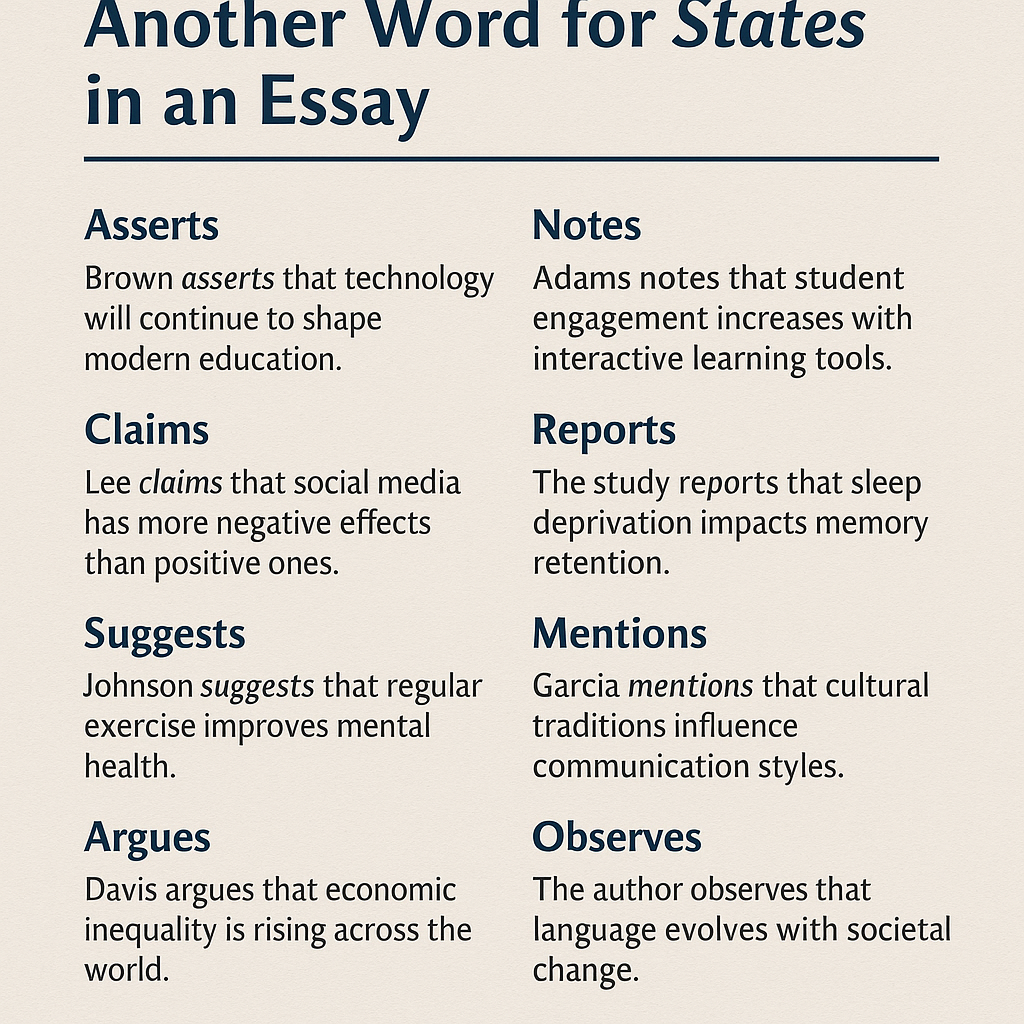

When writing academic essays, students often search for another word for states in an essay to avoid repeating the same verb over and over. Repetition can make writing sound dull, predictable, and less professional. Strong academic writing requires variety, clarity, and precision. That is why finding useful synonyms for common verbs like states can significantly improve the tone and flow of your work.
The verb states is commonly used when summarizing research, quoting authors, or presenting the ideas of others. While this word is correct and acceptable, relying on it too frequently can weaken the quality of your writing. To help you elevate your essay, this article explores the best alternatives and explains how to use each one effectively.
Why Writers Search for Another Word for States in an Essay
When writing research papers or academic essays, you often need to reference what an author says. Many students automatically use the word states because it feels safe and neutral. For example:
- Smith states that motivation plays a key role in success.
While correct, repeating this verb several times makes your writing sound unvaried. That is why many students and writers look for another word for states in an essay to sound more polished and academically sophisticated.
Using a range of reporting verbs helps you:
- Avoid monotony
- Express ideas more accurately
- Sound more confident
- Show understanding of the author’s tone
- Engage the reader more effectively
Academic writing is not just about presenting information; it is also about presenting it in a compelling and clear manner. Choosing the right synonyms is a simple but powerful way to enhance your writing.
Best Alternatives to Use Instead of “States”
There is no single perfect replacement for every situation. Different synonyms carry different tones, strengths, and levels of certainty. Here are the strongest options to consider when searching for another word for states in an essay.
1. Asserts
Use this when the author is making a strong, confident claim.
Example: Brown asserts that technology will continue to shape modern education.
Why it works:
This verb is firm and academic, perfect for persuasive or research essays.
2. Claims
This verb is ideal when the statement may be debatable or controversial.
Example: Lee claims that social media has more negative effects than positive ones.
Why it works:
It shows that the idea is open to interpretation or dispute.
3. Suggests
Use this when the author is offering an idea without strong forcefulness.
Example: Johnson suggests that regular exercise improves mental health.
Why it works:
It sounds thoughtful, neutral, and appropriate for analytical essays.
4. Argues
Use when the writer is presenting evidence to support a specific point.
Example: Davis argues that economic inequality is rising across the world.
Why it works:
It implies reasoning, logic, and debate—ideal for argumentative essays.
5. Explains
Perfect when the author is describing a process, idea, or concept.
Example: Turner explains how climate change affects agricultural patterns.
Why it works:
It shows the author is clarifying or teaching something.
6. Notes
A good option when the writer is making an observation.
Example: Adams notes that student engagement increases with interactive learning tools.
Why it works:
It is gentle, neutral, and works well in formal writing.
7. Reports
Use this when summarizing research findings.
Example: The study reports that sleep deprivation impacts memory retention.
Why it works:
It is commonly used in scientific and technical writing.
8. Mentions
A simple and clear alternative.
Example: Garcia mentions that cultural traditions influence communication styles.
Why it works:
It is neutral and fits almost any academic context.
9. Observes
Use when the writer is offering insight based on analysis or perception.
Example: The author observes that language evolves with societal change.
Why it works:
It feels thoughtful and academic.
10. Highlights
Use when the author emphasizes an important point.
Example: Research highlights the importance of early childhood education.
Why it works:
It signals to readers that the information is significant.
How to Choose the Right Synonym
When looking for another word for states in an essay, choosing the correct verb depends on the context.
Ask yourself:
- Is the author making a strong claim? → Asserts, argues
- Are they offering an idea or possibility? → Suggests
- Are they reporting research? → Reports
- Are they explaining something? → Explains
- Are they highlighting something important? → Highlights
Selecting the verb that best matches the author’s intention will make your writing more accurate and compelling.
Examples of Improved Sentences
Here’s how you can improve repetitive writing:
Before:
Smith states that teamwork improves productivity.
Johnson states that communication is essential.
Williams states that leadership affects performance.
After:
Smith argues that teamwork improves productivity.
Johnson notes that communication is essential.
Williams explains that leadership affects performance.
These variations make your writing more dynamic and engaging.
Final Thoughts
Finding another word for states in an essay is a simple step that can completely transform your academic writing. Using a variety of reporting verbs helps you express ideas more precisely, avoid repetition, and present a more professional tone. Whether you are writing an argumentative essay, research paper, or literary analysis, choosing the right synonyms can elevate the quality of your work.
By mastering these alternatives, you not only improve your vocabulary but also strengthen your ability to communicate ideas effectively. Academic writing is all about clarity, variety, and precision—and replacing overused words like states is a great way to achieve that.