
The Present Indefinite Tense, also known as the Simple Present Tense, is one of the most commonly used tenses in English. It is used to talk about habits, daily routines, general truths, repeated actions, and permanent situations. A present indefinite sentence expresses an action that happens regularly or a fact that is always true.
In this article, you will learn the definition, structures, rules, uses, and many examples of present indefinite sentences to improve your grammar and writing.
What Is a Present Indefinite Sentence?
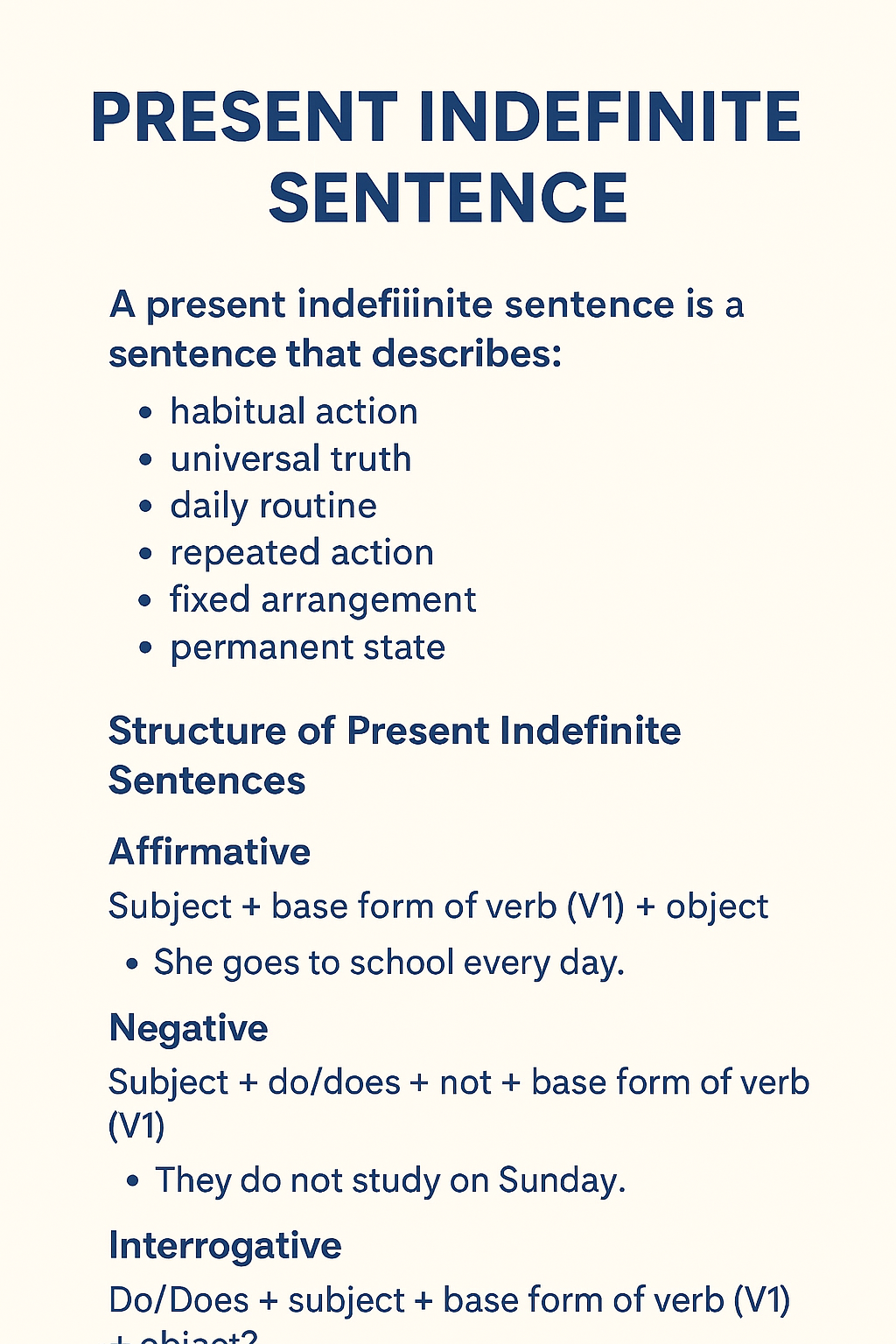
A present indefinite sentence is a sentence that describes:
- A habitual action
- A universal truth
- A daily routine
- A repeated action
- A fixed arrangement
- A permanent state
Example:
- She goes to school every day.
- The sun rises in the east.
These sentences use the base form of the verb, except with he, she, it, where we add s/es.
Structure of Present Indefinite Sentences
1. Affirmative (Positive) Sentence Structure
Subject + base form of verb (V1) + object
Examples:
- I play cricket.
- They study English.
- She plays the piano.
- The shop opens at 9 AM.
2. Negative Sentence Structure
Subject + do/does + not + base form of verb (V1)
Examples:
- I do not (don’t) like cold weather.
- He does not (doesn’t) eat meat.
- They do not study on Sunday.
3. Interrogative (Question) Sentence Structure
Do/Does + subject + base form of verb (V1) + object?
Examples:
- Do you work here?
- Does she speak French?
- Do they play football?
When to Use Present Indefinite Sentences
1. Daily routines and habits
Examples:
- I wake up early.
- She drinks tea every morning.
2. Universal truths or facts
Examples:
- Water boils at 100°C.
- The Earth rotates around the sun.
3. Permanent situations
Examples:
- He lives in Lahore.
- They work in a bank.
4. Instructions or directions
Examples:
- First, you mix the ingredients.
- You turn left at the signal.
5. Future events (timetables and schedules)
Examples:
- The train leaves at 6 PM.
- The class starts tomorrow.
100+ Examples of Present Indefinite Sentences
Affirmative Sentences
- I read books every night.
- She sings beautifully.
- They watch TV after dinner.
- He travels to work by bus.
- Birds fly in the sky.
Negative Sentences
- I do not like spicy food.
- He does not drive a car.
- They do not play chess.
- She does not go to school on Sunday.
- The baby does not sleep early.
Interrogative Sentences
- Do you speak English?
- Does he know the answer?
- Do they play cricket?
- Does the shop open today?
- Do we have class tomorrow?
Present Indefinite Sentences in Daily Use
Here are some natural examples:
For Students
- I study for two hours every day.
- My teacher explains the lesson clearly.
For Work
- I attend meetings regularly.
- She manages the customer support team.
For Home Life
- My mother cooks delicious food.
- We clean the house every morning.
Common Mistakes in Present Indefinite Sentences
❌ Incorrect: She go to school.
✔️ Correct: She goes to school.
❌ Incorrect: He don’t like milk.
✔️ Correct: He doesn’t like milk.
❌ Incorrect: Do she live here?
✔️ Correct: Does she live here?
Always remember:
- Use does + V1 for he, she, it.
- Never add s/es after do/does.
Conclusion
A present indefinite sentence is one of the simplest yet most useful sentence types in English. By learning the structures and practicing examples, you can easily talk about habits, routines, general truths, and everyday actions with clarity and confidence.
If you want, I can also create:
✅ A worksheet
✅ MCQs
✅ Fill-in-the-blanks
✅ Pakistani school-style notes