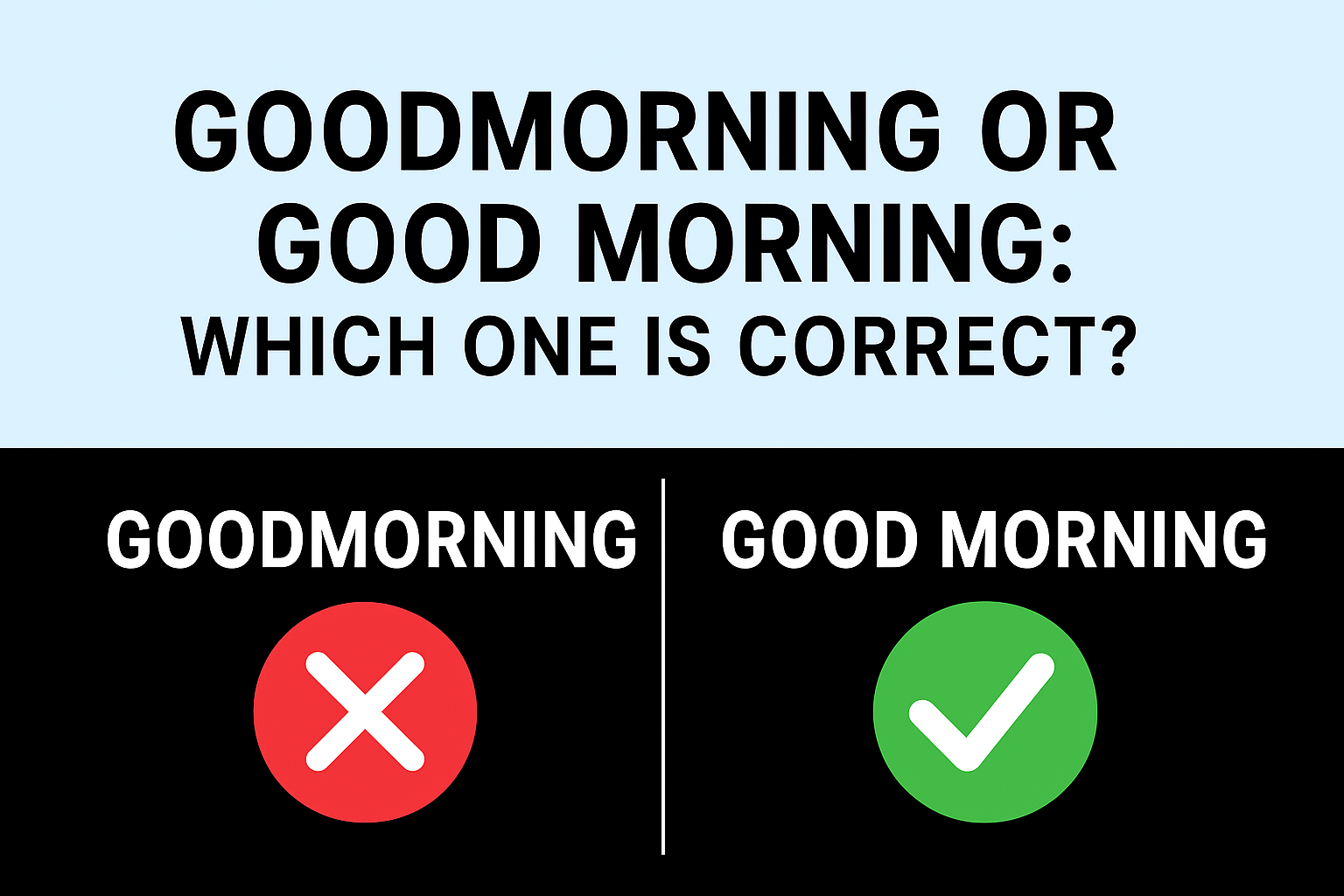

At first glance, both versions look almost identical. But grammar rules say something completely different.
What People Think
Many assume “goodmorning” is correct because it looks like one complete phrase.
What Grammar Says
English requires the words “good” and “morning” to be separate, not combined.
Is It “Goodmorning” or “Good Morning”?
The Correct Spelling: ✔ Good Morning
According to all major dictionaries (Oxford, Cambridge, Merriam-Webster), the correct spelling is good morning — two separate words.
Incorrect Spelling: ✘ Goodmorning
“Goodmorning” is considered wrong in standard English writing.
Why “Goodmorning” Is Incorrect
English greetings like:
- Good morning
- Good evening
- Good night
- Good afternoon
are made of an adjective + a noun, not compound words.
“Goodmorning” incorrectly combines them into one word, which breaks grammar structure.
Why “Good Morning” Is Correct
Let’s look at the words separately:
- Good = adjective (describes something)
- Morning = noun (the time of day)
Together they create a meaningful phrase — not a single word.
Just like you wouldn’t write:
- “Goodnight” → except when saying goodbye
- “Goodevening” ✘
- “Goodafternoon” ✘
You also shouldn’t write “Goodmorning.”
Examples of Correct Usage of “Good Morning”
Here are common situations where “good morning” is used correctly:
Everyday Conversations
- “Good morning! How did you sleep?”
- “Good morning, Mom!”
Text Messages
- “Good morning, I hope you have a great day.”
Professional Emails
- “Good morning, Mr. Ahmed,
I hope you are doing well.”
In Meetings
- “Good morning everyone, let’s begin.”
Examples of Wrong Usage
These are incorrect in formal writing:
- “Goodmorning team”
- “Goodmorning everyone”
- “Goodmorning my love”
Although many people text this casually, it’s not grammatically correct.
When to Use “Good Morning” (And When Not To)
Use good morning whenever greeting someone early in the day.
Correct Use Cases
- Meeting someone in person
- Starting a work email
- Greeting your followers
- Speaking on stage
Not Used For
- Saying goodbye (use “good night”)
- Talking about the time (e.g., “The morning was good,” not “the good morning”)
Capitalization Rules
You may see it written both ways:
1. “Good morning” (Normal Text)
Used in everyday writing.
2. “Good Morning” (Capitalized)
Used when:
- Starting an email subject
- Displaying on greeting cards
- Writing a title or headline
Example:
✔ “Good Morning, Sunshine!”
Why the Confusion Exists
People often type “goodmorning” because of:
✔ Social media habits
Fast typing encourages shortcuts.
✔ Autocorrect errors
Some phones wrongly allow “goodmorning.”
✔ Visual appearance
It looks like it could be one word.
Still, the correct form remains good morning.
Similar Expressions That Follow The Same Rule
These greetings also use two words:
- Good evening
- Good night
- Good afternoon
- Good day
None of these are combined into one word.
Exceptions and Special Cases
Rarely, “Goodmorning” might appear as:
✔ A brand name
Example: “GoodMorning Mattress Company.”
✔ A username or handle
Example: @goodmorning123
✔ A hashtag
#goodmorning (without space)
These are stylistic choices, not correct grammar.
How to Remember the Correct Spelling
Here’s an easy trick:
If you can replace the greeting with another adjective, it must be two words.
For example:
- Good morning → “Nice morning”
- Good evening → “Pleasant evening”
Since “nice morning” is two words, “good morning” must be too.
Should You Ever Use “Goodmorning”?
Only in informal settings like:
- Hashtags (#goodmorning)
- Branding
- Social media usernames
For proper writing, always choose good morning.
Conclusion
So, is it “goodmorning” or “good morning”?
The answer is crystal clear:
✔ “Good morning” is the correct and grammatically accepted spelling.
✘ “Goodmorning” is incorrect and should not be used in formal writing.
Whether you’re texting a friend, emailing your boss, or writing a blog post, using the correct form shows professionalism and clarity. With simple rules and memory tricks, you can avoid this common mistake forever.
FAQs
1. Is “Goodmorning” ever correct?
Only in usernames, hashtags, or brand names. Not in grammar.
2. Should I capitalize “Good Morning”?
Capitalize it only in titles, cards, or headlines.
Otherwise: “Good morning.”
3. Why do people write “goodmorning”?
Mostly due to fast typing, habit, or autocorrect.
4. Is “good morning” one word or two?
It is always two words in standard English.
5. Can I use “good morning” in professional emails?
Yes — it’s a polite, formal, and widely accepted greeting.