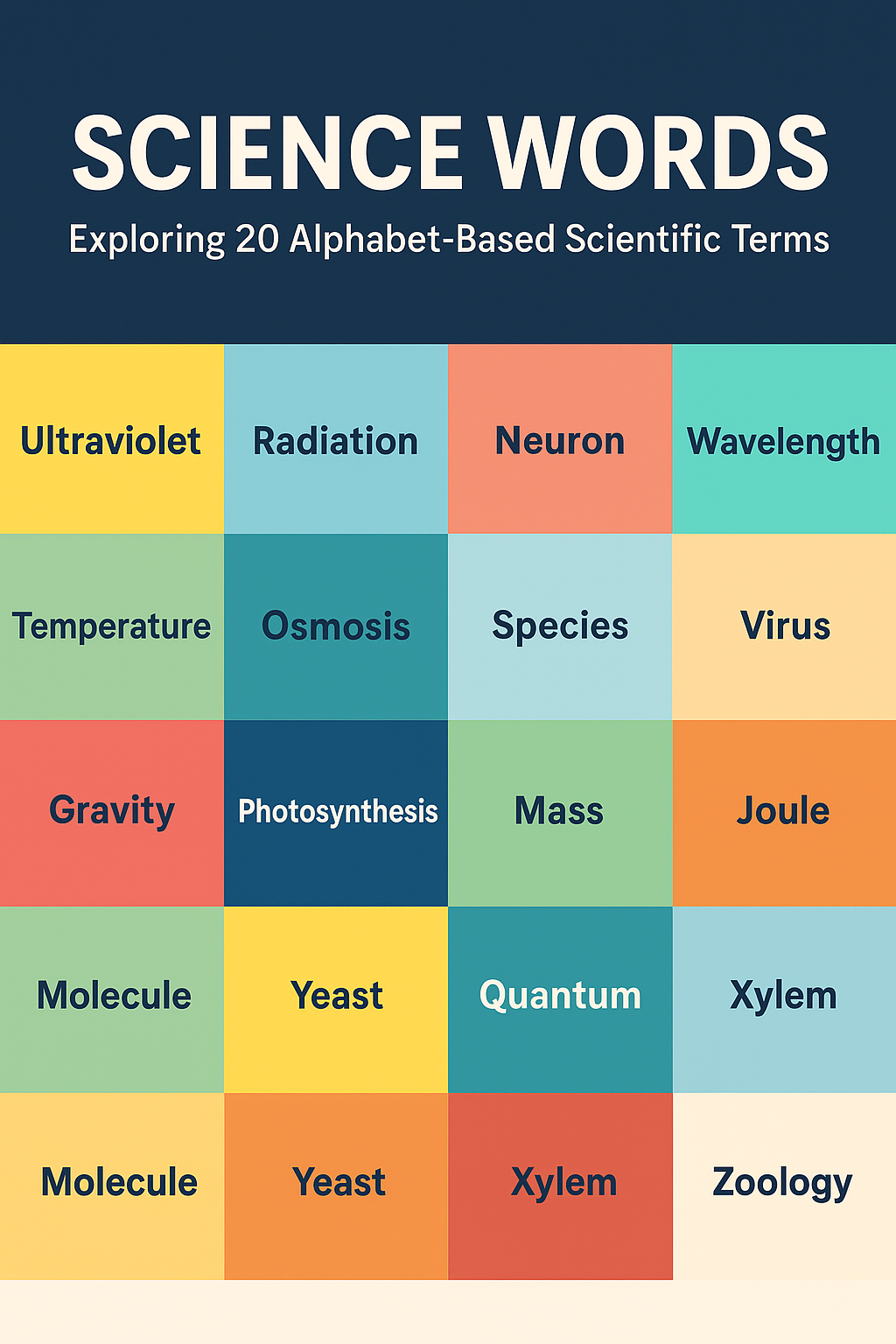

Science is filled with fascinating terminology that helps us understand how the universe works. From biology and chemistry to physics and Earth science, each letter of the alphabet holds powerful and meaningful scientific vocabulary. In this article, we explore 20 different sets of science words, each starting with a specific letter—from U to I—and explain them in simple, engaging language. Each keyword group gets its own paragraph, making the article easy to follow and perfect for readers of all levels.
1. Science Words That Start With U
Science words beginning with U include ultraviolet, unicellular, and universe. These concepts span from the microscopic level to the entire cosmos. Ultraviolet refers to radiation beyond visible light, unicellular describes organisms made of a single cell, and the universe includes everything that exists. These terms show how the letter U connects fields like astronomy, biology, and physics.
2. Science Words That Start With R
Popular science words starting with R include radiation, reactant, and respiration. Radiation relates to energy movement, reactants fuel chemical reactions, and respiration is how organisms convert oxygen into energy. These words play major roles in chemistry, physics, and biology.
3. Science Words That Start With N
Science words beginning with N include neuron, nucleus, and nanotechnology. Neurons transmit signals in the body, nuclei store genetic information, and nanotechnology focuses on creating extremely small devices. N-words help describe life processes, cell structure, and advanced engineering.
4. Science Words That Start With W
Science words starting with W include wavelength, weathering, and weight. These terms reflect ideas from physics and geology. Wavelength measures waves, weathering explains how rocks break down, and weight is the force of gravity acting on mass.
5. Science Words That Start With F
Common science words beginning with F include force, friction, and fermentation. Force drives movement, friction slows motion between surfaces, and fermentation is how microorganisms break down substances to produce energy. These F-words connect physics and biology.
6. Science Words That Start With T
Science words starting with T include temperature, turbulence, and transpiration. These words describe heat energy, chaotic air or fluid motion, and water movement in plants. The letter T bridges environmental science, physics, and plant biology.
7. Science Words That Start With O
Science words that begin with O include osmosis, oxidation, and organism. Osmosis explains water movement across membranes, oxidation involves oxygen reactions, and an organism is any living creature. Many O-words relate to life and chemical processes.
8. Science Words That Start With S
Science words starting with S include species, solution, solar, and spectrum. These terms touch biology, chemistry, and astronomy. Scientists use S-words frequently to classify life, describe mixtures, and understand space.
9. Science Words That Start With V
Science words beginning with V include virus, vaporization, and voltage. Viruses cause infections, vaporization turns liquids into gas, and voltage measures electrical potential. These V-terms connect microbiology, chemistry, and physics.
10. Science Words That Start With H
Science words starting with H include habitat, hydrogen, and hypothesis. A habitat is where an organism lives, hydrogen is the lightest element, and a hypothesis is a testable scientific guess. These H-words shape ecology, chemistry, and scientific research.
11. Science Words That Start With G
Science words beginning with G include gravity, gene, and geology. Gravity pulls objects together, genes carry genetic instructions, and geology studies Earth’s physical structure. These terms span physics, biology, and Earth science.
12. Science Words That Start With P
Science words that start with P include photosynthesis, particle, and pressure. Photosynthesis lets plants convert sunlight into energy, particles form all matter, and pressure measures force per area. P-words describe basic scientific principles.
13. Science Words That Start With M
Science words beginning with M include mass, molecule, and metabolism. Mass measures matter, molecules build everything around us, and metabolism powers living organisms. M-terms appear in almost every scientific field.
14. Science Words That Start With J
Science words starting with J include joule, jet stream, and junction. A joule measures energy, the jet stream influences weather, and a junction connects different pathways such as nerve cells or circuits.
15. Science Words That Start With B
Science words that start with B include biome, bacteria, and buoyancy. A biome is a large ecological region, bacteria are microscopic organisms, and buoyancy determines whether objects float in a fluid.
16. Science Words That Start With Y
Science words beginning with Y include yeast, yield, and ytterbium. Yeast helps in baking and brewing, yield measures scientific output, and ytterbium is a silvery metallic chemical element.
17. Science Words That Start With Q
Science words that begin with Q include quantum, quark, and quadrant. Quantum describes the smallest levels of energy, quarks form particles like protons, and a quadrant is a math term used for measurement and graphing.
18. Science Words That Start With X
Science words starting with X include xylem, xenon, and X-ray. Xylem transports water in plants, xenon is a noble gas, and X-rays help doctors view internal body structures.
19. Science Words That Start With Z
Science words beginning with Z include zoology, zygote, and zirconium. Zoology studies animals, zygotes begin life after fertilization, and zirconium is a strong metal used in science and industry.
20. Science Words That Start With I
Science words starting with I include ion, inertia, and immunity. Ions are charged particles, inertia resists changes in motion, and immunity protects the body from disease.
Conclusion
Science vocabulary is incredibly vast, spanning every letter of the alphabet and touching every part of the natural world. From the microscopic to the cosmic, these 20 groups of science words help us describe, explore, and understand the universe with greater clarity. Whether you’re a student, educator, or science enthusiast, expanding your scientific vocabulary opens the door to a deeper appreciation of how everything works.
FAQs
1. Why are science words important?
Science words allow us to explain complex ideas clearly and accurately across different fields.
2. Are these science words used in schools?
Yes, many of these terms appear in biology, chemistry, physics, and Earth science curricula.
3. What is the easiest science word for beginners?
Words like mass, gene, and habitat are easy to understand and commonly used.
4. Why do some letters have fewer science words?
Letters like X, Y, and Q are less common in English, so fewer scientific terms start with them.
5. Can I use these words for teaching?
Absolutely—these examples are great for classroom vocabulary lists or science projects.